
The Founding of the RAN Armament Depot Newington
Introduction
"In 1921 management of the Depot was transferred from the Royal Marine Garrison to the Royal Australian Navy."
A Google search produces about 14 references similar to the above; all are incorrect and have resulted from uncritical copying from a single source. (Fortunately, in 2024 only 2 of these links remain. Unfortunately, one is in Newington's entry in the Australian Heritage Database).
This claim had its origins in a brief history of Newington prepared about 1968. It has been "copied and pasted" often since then.
There was no Royal Marine Garrison in NSW in 1921, and none in 1897 and 1898 when the Newington Magazine was constructed. British "garrison" troops departed Australia in 1870 when the colonies assumed responsibility for their own military defence. A few Royal Marines worked at the Royal Navy Ordnance Depot on Spectacle Island, or at the naval base at Garden Island, up to their handover to the RAN in 1913, but did not constitute a separate force requiring an explosives magazine for its support.
The claim is also counter-intuitive. At the time of the first construction (long-delayed) at Newington in 1897, the Royal Navy ammunition and explosives were located at Spectacle Island, which was being actively expanded through the 1890s and early 1900s.
Relieving the Overcrowding
There is abundant evidence in reports of parliamentary debates in the pages of the Sydney Morning Herald during the 1870s and 1880s that Newington was an endeavour of the NSW colonial government to relieve overcrowding at the Goat Island magazine and other explosives storages around the harbour, such as Berry's Bay, which was used by the Torpedo Corps, an element of the New South Wales Military Forces. The explosives in question comprised "merchant's powder" (i.e. commercial explosives, by that period comprising more than just gunpowder) and the ammunition and explosives used by the Royal Navy Squadron and New South Wales Military Forces.
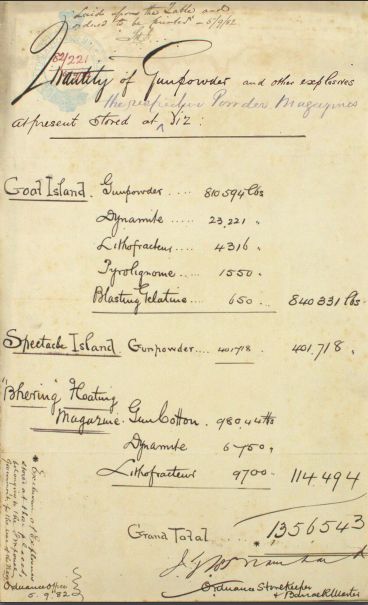
(Legislative Assembly NSW, tabled 5 September 1882)
An early reference is from the Sydney Morning Herald of 27 October 1875, page 7, reporting the recommendations of a Board appointed by the government of the Colony of NSW into the removal of the Goat Island magazine. Recommendation 2 was "That a separate and distinct magazine for merchant's gunpowder, capable of storing about 300 tons, be established on the right bank of the Parramatta River...".
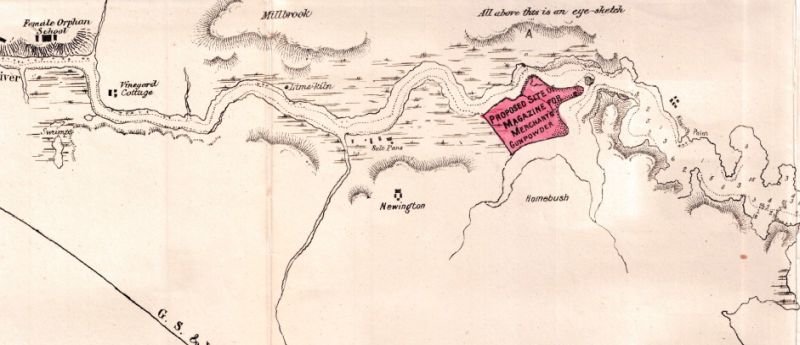
The issue was debated in the NSW Parliament in October 1881:
"FRIDAY, OCTOBER 7, 1881
In the Legislative Council yesterday. ...
Mr. O'Connor moved the adjournment of the House for the purpose of bringing under notice the great danger to which both life and property were exposed from the criminal carelessness of the Government in allowing enormous quantities of explosives to be stored close to Sydney; ...
Mr. Watson said the subject had occupied the attention of the present and previous Governments. There had been great difficulty in getting a new and suitable site for a magazine, and one had at last been selected by a board, which had been adopted by the Government, and directions had been given for the preparation of plans for the work. ...
Mr. Day said the amount of explosives stored at Goat Island was beyond belief, and placed 50,000 lives in jeopardy. Mr. Reid suggested that the new magazine should be established in some part of Middle Harbour. Mr. Watson interjected that the new magazine would be at Newington. Mr. Burns, Dr. Renwick, and Mr. Pigott would prefer the selection of a site at Middle Harbour. ...
Mr. Henson thought they were not likely to have many buildings near the site at Newington for a long time. ..." (Sydney Morning Herald, 7 October 1881)
Mr Henson was prescient; 16 years were to pass before building got under way.
Samuel Charles, of 9, Richmond-terrace, Domain, became passionate on the subject in the Sydney Morning Herald of 27 February 1882:
" Sir, I see by this morning's Herald the Government have decided to erect new powder magazines at Newington. This shows that they are aware of the danger, but ignorant of the effect of an explosion.
When the Thames embankment was blown away by the explosion of powder in a lighter the Hereford Powder Mills, which were at a considerable distance from the river, went off simultaneously. The result would be the same at Newington if two or three magazines are erected on a patch of two and a half acres as proposed. To be plain, I think the Government, if not acting criminally, are at least, most negligent of their duty to the citizens of Sydney They are the parties charged with the storage of explosives, and although warned of the great danger, over six years past, they have allowed explosives to accumulate to such an extent that the lives and property of every citizen is in danger.
To show how negligent the Government have been, it is only necessary to state that in August, 1876, £15,000 was voted for a new magazine, nearly 6 years have passed, and now we are told that instructions have been given to make plans for magazines. When will they be ready for the receipt of powder? Judging from the past, I would say, when the inhabitants of Newington are numerous enough to demand its removal.
The whole proceedings are a criminal trifling with the lives of the citizens. Why not purchase or rent a couple of hulks, and remove the danger at once. But, I suppose the Treasurer will say he has not money or authority for the purpose. My answer is that vessels have been purchased and sanatoriums erected (without sanction) at ten times the cost required for hulks, and that for a much less danger than the explosives in our magazines. ...
However, I do wonder at times how the Treasurer can sleep in a thunderstorm knowing the magazine was once struck by lightning when it was not surrounded with sheds filled with explosives, as at present. The same may occur again and if he escaped the explosion he would have many lives to answer for.
I do not pretend to know much of law, but I do know that if a private person, in company, or a corporation created or permits a danger to the public to exist, the law will compel them to remove or abate it. The Mayor should bring the matter before the Supreme Court, where it would be easy to prove the storage of such a large quantity of powder on Goat Island dangerous to the citizens, when I am sure the Judges would order its immediate removal.
In the event, the commercial explosives were dispersed to storage hulks until such time as permanent magazines at Middle Harbour were completed, and the military stores to Newington. This took much longer than expected. In 1905 the Balmain Borough Council, acting on residents complaints of excessive noise, prevailed on the military authorities to cease the disposal there of obsolete Martini-Henry cartridges by removal of the bullets and firing of the resultant "blank" cartridges. (Sydney Morning Herald, 22 March 1905, page 5). Explosives were finally removed from the Island in 1907; the following year the Commonwealth Government relinquished its claim to the Island. However there is evidence that Commonwealth stores, probably including ammunition, returned to the Island at a later date. This may have resulted from a temporary shortage of ammunition storage that affected both the Army and Navy immediately after World War 1.
Resuming the Land
In 1882 an area of 248 acres 1 rod and 8 perches at Newington in the parish of St John, county of Cumberland was resumed for "certain works for and in connection with the erection of a magazine for the storage of gunpowder and other explosives and certain buildings in connection therewith." (Government Gazette No. 334, 22 August 1882, page 4317)
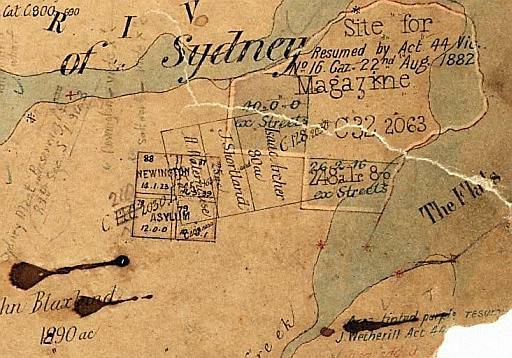
Together With Earliest Land Grants
to Waterhouse, Shortland and Archer
Designing What?
The 2013 Conservation Management Plan for the Newington Armament Depot and Nature Reserve states that "The original buildings, constructed during the 1890s, are associated with the Colonial Architect's Office under the direction of James Barnet and the Government Architect's Office under the direction of Walter Liberty Vernon". The only evidence given for this attribution is a letter from William A. Brodribb, who described himself as a member of the Legislative Council, published in the Sydney Morning Herald of 14 February 1883. In this letter he wrote:
"The Government have resumed 217 acres of land at the Newington Flats on the Parramatta River, where there is sufficient dry land for the magazines ... This site was recommended by the [Storage of] Gunpowder Board, and is is intended to erect there three separate magazines protected by large mounds of earth. £20,000 have been voted by Parliament for that purpose. Plans are now being completed in the Colonial Architect's Office, and as soon as they are ready immediate action will be taken in the construction of the buildings."
One of the witnesses (Major C. Roberts) at the Storage of Gunpowder Board hearings in 1875 was an ex-Royal Artillery officer. His evidence bore on the question of differing standards of magazine construction for commercial and military explosives. This is his opinion:
"857. What is your opinion with respect to the construction of a powder magazine; do you think it ought to be a lightly constructed building, or a more solid bomb-proof erection? With regard to Goat Island I should say the lighter the better. 858. A magazine for the storage of ordinary mercantile powder? Certainly it should be a light building something like the field magazines, which have little more than wooden sides covered with earth and well covered with earth on top. Of course that would be rather dangerous here on account of bush fires, and you would have that to consider. So that perhaps it might be better to have a light brick building."
A similar opinion was expressed by Commodore Goodenough R.N., the Commander-in-Chief, Australia Station, who also gave evidence to the Board.
The Board's report is available to read or download.
This style of light magazine construction (later referred to as frangible) would have been consistent with the recommendations of the 1865 Committee on Government Magazines and Depots of Gunpowder, which recommended that future magazine establishments should be composed of small units placed well apart and traversed, holding 2,000 barrels each. (David Evans, Arming the Fleet - The Development of the Royal Ordnance Yards 1770-1945, p.82) 2,000 barrels equals 90 tons of gunpowder.
It is therefore likely that the Colonial Architect James Barnet's plans in 1883 were for lightly constructed buildings with earth traverses, as at that time the intention was still to use Newington for commercial explosives. Barnet had been a member of the 1875 Board, so was well aware of the opinions given to it.
In the event, by the time construction got under way 14 years later, the purpose had changed to storage of military explosives and what was constructed was a triple-arch, heavy Vauban-style magazine, with ancillary buildings more suited to military than commercial explosives (i.e. a shell and cartridge filling laboratory).
In the intervening period, the office of Colonial Architect had been abolished as a result of the Royal Commission on Defence Works in 1891. Barnet had resigned in 1890. In 1889 the Government had created the Military Works Branch of the Public Works department, headed by Lieutenant-Colonel F. R. De Wolski. By 1893 the military design function had been transferred from Public Works to the Commanding Engineer on the HQ staff of the NSW Military Forces (NSW Military Forces General Order 150 of 20 July 1893).
It is therefore most likely that the design of the initial buildings at Newington originated with the engineering staff of the NSW Military Forces as the 3 key buildings, the magazine, laboratory and the examining room are straight from the Royal Engineers "pattern book" of Victorian Era military designs. Army laboratories with similar floor plans to that at Newington were designed for Enoggera, Queensland c.1903, and Fort Nelson (Hobart), Tasmania c. 1918. More information on the magazine's design is available.
If the buildings were designed by the military staff, then probably Captain Percy Thomas Owen played a major part. Owen was staff officer to Colonel H.W. Renny-Tailyour, R.E., the Commanding Engineer of the NSW Military Forces 1891-1894, and headed the military engineering staff from 1895 to 1899. An experienced practical civilian engineer, he also qualified at the Military College of Engineering at Chatham in the UK in 1894, where he would have been exposed to the design principles embodied in the Newington magazine. Owen subsequently had a distinguished military and civilian engineering career. A fuller biography of him can be found at the Australian Dictionary of Biography.
Others were no doubt involved in the design process. On 22 January 1897, before construction commenced, two other military engineers visited Newington to inspect the site. They were Lieutenant and Quarter-Master Arthur James Pinchen and Major Henry Alexander Lee. Pinchen in 1897 was Division Officer, South and may have supervised the actual construction at Newington as he had also been appointed Clerk of Works. Major Lee had been appointed Commanding Officer, No. 3 Company Submarine Miners in 1894 and therefore had an interest in the storage of explosives. Like Captain Owen he had also attended the Military College of Engineering although in his case it was to study submarine mining. (The Daily Telegraph, 23 Jan 1897, p.11)
Percy Owen, by then a Major, visited the Newington Magazine in 1901 as a member of the Military Committee of Inquiry, which was set up to procure information with regard to the organisation and instruction of the existing Military Forces and the arrangements for the inspection of warlike stores, military supplies and contracts.
A Military Magazine
According to the Report of the Committee into State Properties transferred to the Commonwealth published in 1903, the Magazine was "a comparatively new work, completed in 1898 in four contracts amounting to 17,793 pounds."
Construction got underway in early 1897 and continued on through 1898. Details of two of the contracts have been traced.
A notice appeared in the Sydney Morning Herald of 6 March 1897 calling for tenders for the erection of a "Magazine, Laboratory, Gun Cotton Store and other buildings" at the Military Reserve at Newington. The notice is in the name of the New South Wales Military Forces.
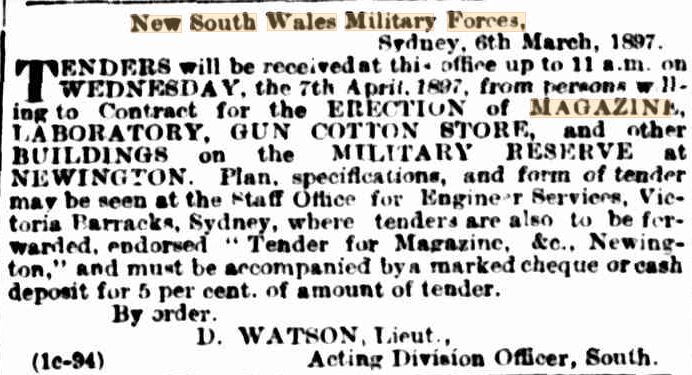
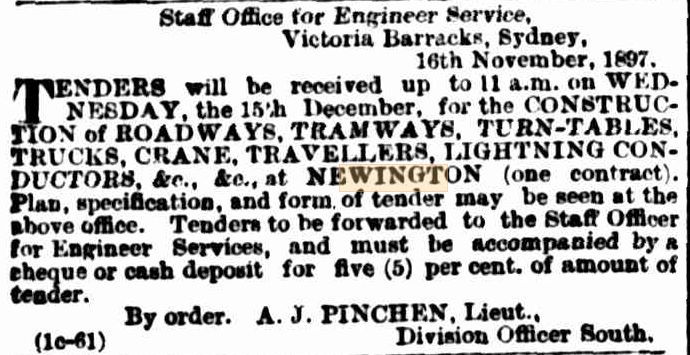
Tenders were called for the plant and equipment for the Magazine on 20 November 1897:
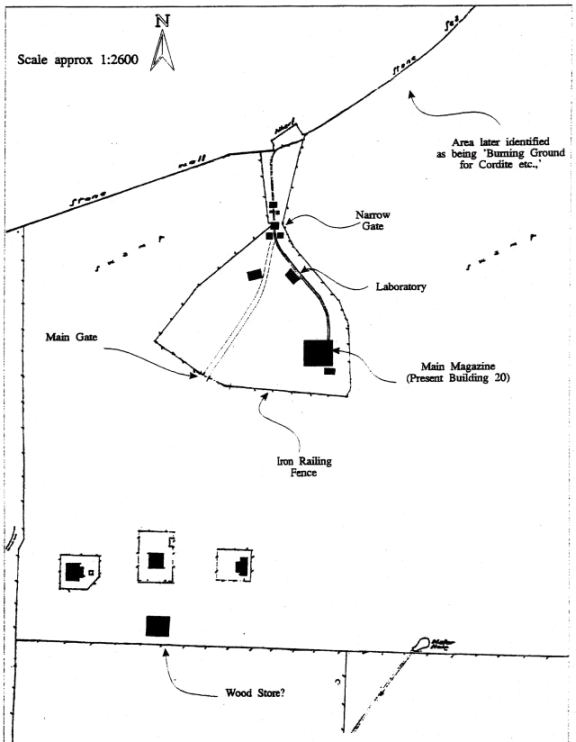
the original source of this plan isn't known.
Soldiers quarters are at bottom left.
An article in the Cumberland Argus and Fruitgrower's Advocate of 4 September 1897, reporting on the construction of the Magazine, says that: "...the Government Powder Magazine at Newington, where it is intended to store all the powder required for military purposes in the colony..."
It also said, amongst other things:
"There is to be a cooperage for the repairing of barrels, an examining room and a laboratory, for the making up of cartridges, and a gun-cotton store for the storage of dry gun-cotton. A convenient wharf has been placed on the river, and the river is to be deepened to the wharf. From the wharf, on which the iron gates will form the main entrance, there will be a thorough system of tram lines running around the reserve. One line will run to the gun-cotton store on the right hand side, and a double line of rails will run to the powder magazine."
Of the buildings mentioned (there was also a latrine and soldier's quarters), all are shown on the map below, with the exception of the gun-cotton store (which is outside the area covered by the map).
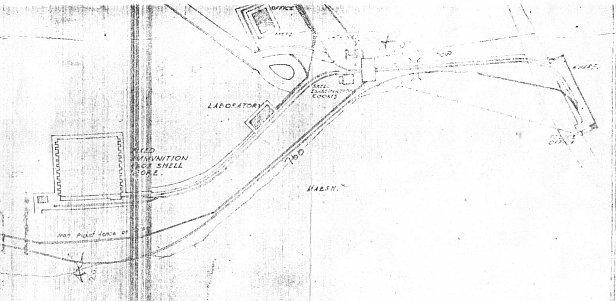
shows the original magazine precinct, its surrounding iron picket
fence and tramway tracks, including those within
a cutting and running to the gun cotton magazine.
North is to the right.
View an album of photos showing the surviving buildings constructed at Newington in 1897-98.
The gun-cotton store no longer exists. It is shown on a 1928 map, occupying a position now occupied by a later explosives storehouse (Building No. 8) erected around 1940. It had been, in any case, replaced by 3 new guncotton storehouses constructed around 1922 (Building Nos. 36-38) on the eastern side of the Depot.
The 1897 buildings at Newington were erected by Mr John Howie, a prominent Sydney master builder, according to his obituary published in the Sydney Morning Herald of 15 October 1917.
The following table relates the buildings known to have been constructed in 1897-98 with the buildings as they exist now.
| Building Name | Building Number | Notes |
| Powder magazine | 20 | - |
| Laboratory | 140 | - |
| Dry gun cotton store | Demolished | Probably demolished when Bldg 8 constructed. |
| Warrant officer's cottage | 123 | - |
| Men's quarters (4) | 118 & 126 | Comprised 2 semi-detached residences |
| Examining room | 142 | - |
| Latrine | 148 | - |
| Guard house | 139 | - |
| Cells | 139 | Contained within guard house |
| Lamp room | ? | Location not positively known - most likely integral with the Guardhouse, although Building 137 is also a possibility. |
| Cooperage | 143 | Now usually known as the Gatehouse |
| Unknown | 137 | Located adjacent to the gunpowder magazine |
The original function of Building 137 isn't known, although its proximity to the magazine suggests a functional relationship between the two structures. The most likely use was as a non-explosive component/tool store and/or office.
Manning the Magazine
On 18 June 1895 the Government Gazette recorded the formation of:
"Ordnance Store Corps: "C" (Ordnance) Branch of the Military Secretary's Department, now a civil branch, to be converted into an Ordnance Store Corps."
"The Corps comprised No 1 Gun Wharf Section with a Deputy Assistant Commissary General of Ordnance, a Lieutenant and Quartermaster, three Conductors of Stores and one Sergeant Artificer. No 2 Magazine Section was composed of one Conductor of Stores and three Privates; and No 3 Armourer's Section was composed of a Lieutenant and Quartermaster, with one Armourer Sergeant and two Privates. These appointments were filled by members of the permanent military forces." (John D. Tilbrook, To The Warrior His Arms - A History of the Ordnance Services in the Australian Army, Chapter 2 page 25)
It is the Ordnance Store Corps, and specifically the No. 2 Magazine Section, that is likely to have been the commissioning unit at the Newington Magazine around 1898.
A history of the Australian Army Ordnance Corps "To the Warrior His Arms" (available at the RAAOC Association website) says: "...On 15 September 1902 the following Warrant Officer, Non-Commissioned Officers and Gunners were attached to the newly formed No 4 Company pending transfer to the Ordnance Stores Corps....The following N.C.O. and men employed at the Newington Magazine were attached to No. 2 Company also pending transfer to the Ordnance Stores Corps.
Sergeant T. Walker
Gunners G. Jennings, T. Campbell and W, Clarke..."
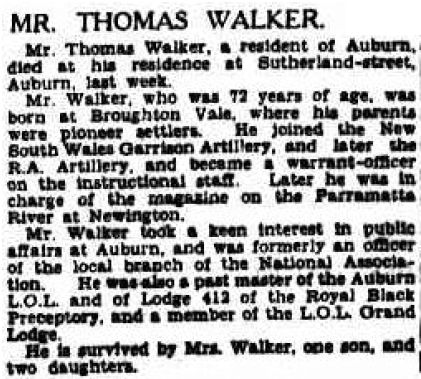
(Thomas Walker: born 1859 (NSW BDM 8462/1859; died January 1932 (NSW BDM 873/1932). According to a funeral notice for his son John, published in the Sydney Morning Herald of 26 April 1919, Thomas, by now a Warrant-Officer, was still working and living at Newington at that time.)
The Navy Takes Over
After World War 1 the Australian Military Forces decided to centralise its ammunition storage in the Sydney area at the Ordnance Depot at Liverpool. (Australian Military Forces files of the time sometimes refer to this as the Explosives Depot and the location is sometimes given as Moorebank. This depot was located at Anzac Road, Moorebank.)
On 22 December 1917 Captain Thring, then Director of War Staff and Director of Naval Ordnance wrote to the First Naval Member:
"The Commonwealth Cordite Factory is now turning out a certain amount of gun cordite. The first lots will be made up into practice charges for 4" guns and below. It is proposed to carry out this work at Spectacle Island..."
Thring went on to point out the unsuitability of Spectacle Island for such work and indeed for any storage of explosives and concluded by recommending:
"In my opinion the magazine should be removed to a safer locality before the return of our ships and I submit that this question should receive early consideration by the Naval Board."
At the conclusion of the First World War, the Naval Board not only had to consider the storage of the reserve outfits of the returning ships but also the manifest unsuitability of Spectacle Island for storage of explosives.
In October 1918, the 3rd Naval Member argued that additional magazine accommodation should not be built at Sydney as the Naval Base itself should be removed from there. Two months later the Director of Naval Ordnance, Captain Stevenson recommended that main magazines be built at Flinders Naval Base in Victoria. In the same month, the Admiralty were asked what the probable cost would be for a ship suitable to be used as an ammunition supply ship for reserve ammunition. In April 1919, Admiralty offered HMS Magnificent for the purpose, with the cost of conversion estimated as £180,000. Magnificent had already been converted for Royal Navy use.
In the event, the Naval Board decided to delay a decision until after the impending visit of Lord Jellicoe. By June, 1919, the proposal had been abandoned. HMS Magnificent served as an ammunition ship in Royal Navy service until 1921.
During the latter part of 1919 the matter was taken to Cabinet, and the attention of the Prime Minister was drawn to the dangerous state resulting from the lack of ammunition reserves.
A minute N.17/0144 dated 1 April 1920 from Captain C. Round-Turner, RN, Director of Ordnance, Torpedoes and Mines, to the First Naval Member provides some background to the transfer of Newington to the RAN. In this minute Round-Turner writes that he met with the Australian Military Forces Chief of Ordnance on 12 March 1920, and was advised that Newington would be made available "for the storage of the Reserve Ammunition of the Navy." The reserve ammunition comprised 2 outfits for each ship on station plus 2 year's practice ammunition. Round-Turner then visited Newington on 24 March 1920 and decided that it would be suitable for the storage of about half of the reserves, and that additional storage would be necessary. Further, he regarded Newington as an unsuitable permanent site due to its proximity to the coast leaving it open to attack from both air and sea. He concluded with:
"We are faced, as we have been ever since 1906, with the imperative necessity of constructing a modern magazine and shell store of sufficient size to accommodate all the reserve ammunition for the existing Australian Navy, and to allow of expansion to meet future needs; or in the event of the adoption of Viscount Jellicoe's proposals of smaller magazines and shell stores at each of the main Naval Bases. As the full proposals cannot in any case materialize for some time it is important that the magazine in connection with the Eastern Base should be commenced without delay; plans and estimates for this have already been prepared."
Between March and September 1921 investigations were made into the possibility of converting a railway tunnel at Otford into magazine storage; the cost was estimated to be £248,000. Advice was then sought from the Admiralty as to the suitability of the proposal. Although the outcome of this enquiry isn't known, it's clear from the construction program that by 1923 expansion at Newington, together with the development of the Swan Island Mine Depot, had been accepted as the preferred option for the medium term.
In summary, the Newington Magazine was built for the New South Wales Military Forces and the transfer in 1921 was from Australian military use to Australian naval use. It's likely that the transfer of the property was simply an internal re-arrangement within the Department of Defence as the Australian Military Forces's Ordnance Department was at that time a civil agency of the Department. 1921 was also the year the Department of the Navy was merged into the Department of Defence. (Robert Hyslop, Australian Naval Administration 1900-1939, Melbourne 1973, p.33)
More information is available about the activities conducted at the Magazine.
Information concerning the Otford Tunnel and HMS Magnificent is drawn from a contemporary "Summary of Action" referencing Navy Office files 17/0144, 21/086, 21/0145 and 21/0174.
Further information on the issue of storage arrangements for the RAN's ammunition circa 1919 - 1921 can be found in:
John Mortimer, "Naval Administration 1919-23: Lessons for Today's Royal Australian Navy", Australian Maritime Issues 2008 - SPC-A Annual (Papers in Australian Maritime Affairs No. 27) ed. Gregory P. Gilbert & Nick Stewart Pp.145-194. ISSN 1327-5658/ISBN 978-0-642-29701-3.
For further information about the Navy's development of the depot visit:
- RAN Armament Depot Newington in 1929
- RAN Armament Depot Newington in 1937
- The Experience of War at Sydney - 1939 to 1945
Like to know more? Check out other pages via the Site Map.
This webpage is referenced in the NSW Heritage Register, Item Number 01850, Newington Armament Depot and Nature Reserve.
Material on this page may be copied for personal use. If you intend to republish any substantial part of the page in any manner, please acknowledge the source and provide the URL of the page.
