
RAN Mine Depot Swan Island
Introduction
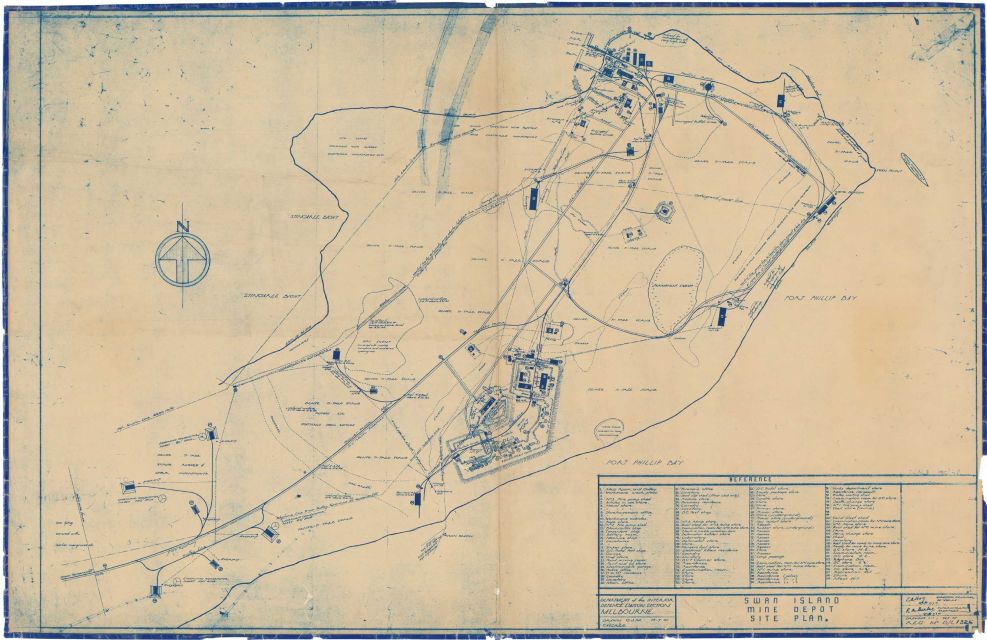
Swan Island is a sand barrier island at the western entrance to Port Phillip in Victoria, Australia. Before being used as a Mine Depot, it had a long history of use for military purposes, dating back to pre-Federation times.
Foundation
On 22 December 1917 Captain Thring, then Director of War Staff and Director of Naval Ordnance wrote to the First Naval Member:
"The Commonwealth Cordite Factory is now turning out a certain amount of gun cordite. The first lots will be made up into practice charges for 4" guns and below. It is proposed to carry out this work at Spectacle Island..."
Thring went on to point out the unsuitability of Spectacle Island for such work and indeed for any storage of explosives and concluded by recommending:
"In my opinion the magazine should be removed to a safer locality before the return of our ships and I submit that this question should receive early consideration by the Naval Board."
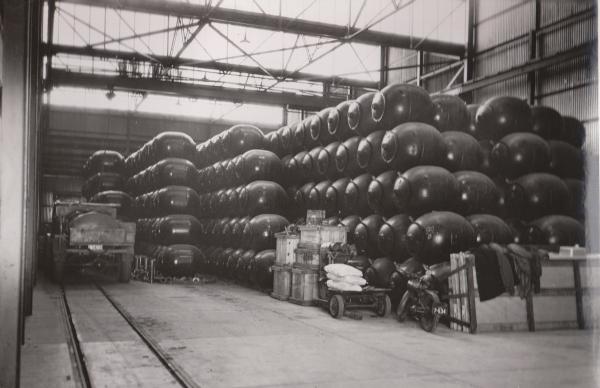
At the conclusion of the First World War, the Naval Board not only had to consider the storage of the ammunition outfits of returning ships but also the manifest unsuitability of Spectacle Island for storage of explosives. In addition, in 1920 the Naval Board accepted the offer of 2,000 "H" mines as a free gift from the Admiralty. These mines arrived in Australia in August 1920 and were first disembarked at Flinders Naval Depot. The question then arose of providing proper storage accommodation, and a site at Swan Island in Port Phillip Bay, Victoria, was selected and buildings erected. The mines were moved to Swan Island in 1921 and certain additional accommodation, in the shape of an old fort, was taken over from the Army. Depth charges were also removed from Sydney between about 1921 - 1923 and were also stored at Swan Island.
(Note: Early British mines had both a "type" letter and a Mark number. "H" mines were buoyant horned mines, with Hertz (acid) horns. "T" mines were similar, but with Trigger (switch) horns. "L" mines were shore-controlled. For more information on mines, visit the NavWeaps website.)
The Inter-war Years
The Swan Island depot was considered to be a very good one for the purpose, well isolated and capable of expansion. As it existed at the end of 1923 it provided storage accommodation only, and it was planned to proceed with further development in financial year 1924/25. This was to comprise a Ready for Issue Store and a pier to enable mines to be prepared for laying and embarked in a Mine Layer.
The Swan Island Tramway
From about 1885 Swan Island was connected to the mainland by a horse-worked 3-foot gauge railway running over timber bridges. The photo below shows an improvised motor haulage arrangement said to have been used in the early 1920s.
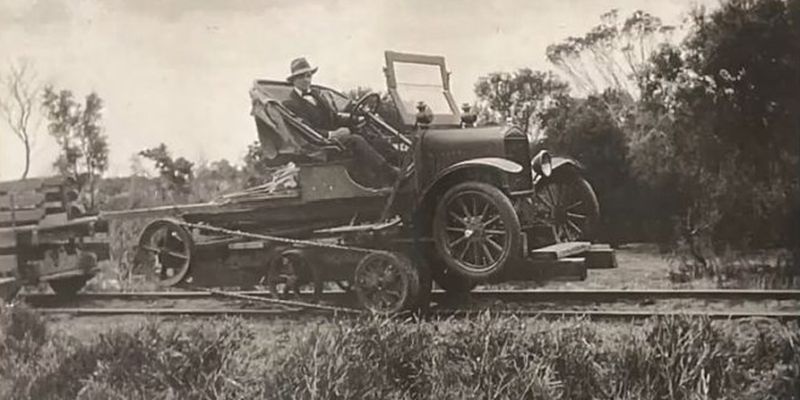
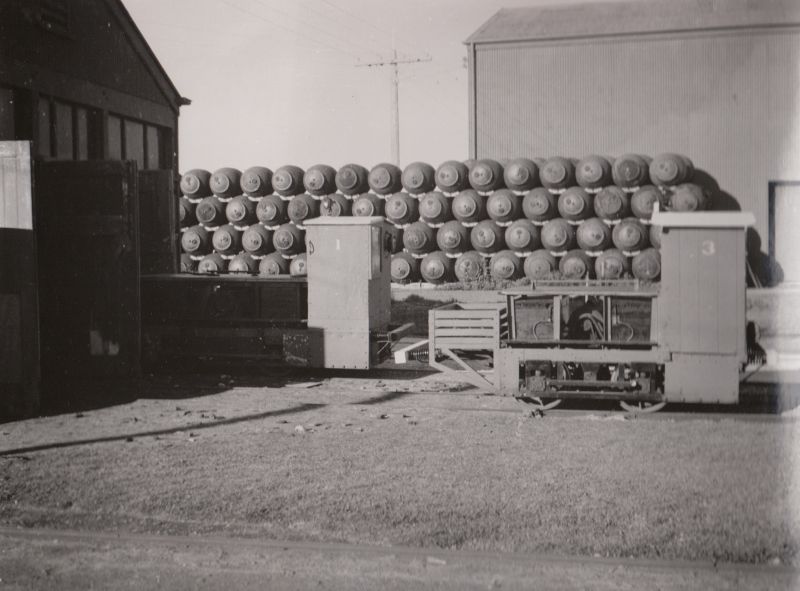
This was probably unsuccessful because "In 1924 the Navy ordered the first of three Electromobile battery locos. It was a Type 2-M, rated at 4hp, could pull 18 tons at 6mph and was ordered through Tombs & Howcroft Pty Ltd, an agent in Melbourne, costing £415. In 1926 a further one was ordered, this time directly from Otley and cost £534 and 16 shillings. This was an improved version fitted with a cab, spring buffers, sand boxes and an additional brake, and rated at 8hp. These locos were clearly a success as a third one was ordered the following year."(http://www.leedsengine.info/leeds/histeo.asp - accessed 11 December 2023). Two of these locos are shown in the 1953 photo below.
Anecdotal evidence is that the tramway was closed and removed around 1958.
World War 2
The Argus of 6 February, 1939, in an article on Australia's rearmament plans, quoted the Prime Minister Mr Lyons as saying that a "Mines Depot will be re-established at Swan Island...". (This suggests that operations at the depot were wound down during the depression years of the 1930s.) A similar announcement was made by Prime Minister Menzies when announcing plans to lay defensive minefields along the coast of Australia (The Argus, 12 September 1940, page 1)
During World war 2, the depot was supplemented by subsidiary depots at Fyansford and North Geelong.
The following quote describes British policy for processing mines for embarkation during the war:
"With regard to the actual preparation of the mines for laying, as opposed to their assembly, it had previously been the practice for this to be done in full by the minelayers themselves. This policy was reversed, and the preparation of the mines and their examination after transit, e.g. assembly at Frater [mine depot] and examination and embarkation at Immingham, became the responsibility of the depot organization, manned by civilian personnel under the Director of Armament Supply at the Admiralty. Work on board the minelayers was thus confined to carrying out the final functioning tests, setting the required depth, making the necessary adjustments to flooder clocks and delayed release mechanisms, &c., if fitted, and inserting the primers and detonators. Under this scheme, fewer skilled ratings were required in the minelayers, work in the depots was more rationally spaced, and the turn-round between successive operations was reduced to the time required to embark the mines, refuel, and afford the necessary rest and relaxation to the crews." (J. S. Cowie, Mines, Minelayers and Minelaying, Oxford University Press, 1949, p. 117)
According to the official war history (Volume V – The Role of Science and Industry (1st edition, 1958, chapter 13):
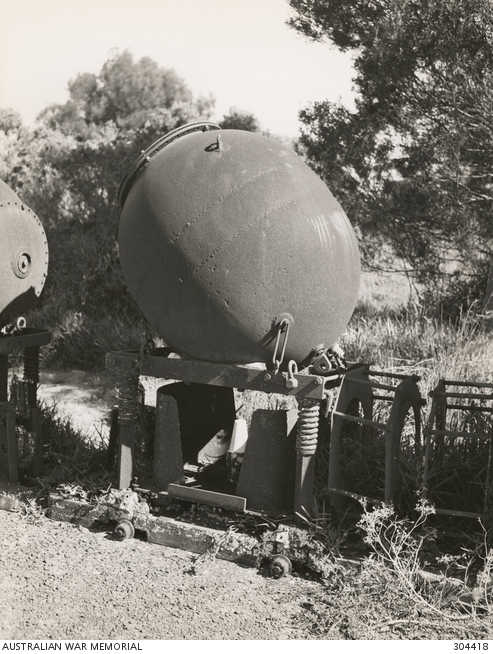
The completed mine units (shell and sinker) from the annexe at Geelong, and the charge cases which had been filled with T.N.T. at Maribyrnong, were taken to the Mine Depot at Swan Island, Victoria, where each mine was assembled and "married" to the sinker before it was loaded into the minelayer."

There is a brief mention of the transportation of the mines in the Naval History Podcast "The RAN & Mine warfare in World War II" in which it is stated that the mine shells, TNT-filled charge cases and sinkers were assembled at Swan Island without detonators and primers and then transported by rail to Geelong.
At some point the assembly task was transferred to the Fyansford sub-depot. File dates of relevant files in the National Archives of Australia, particularly NAA: MP150/1, 569/216/1342, suggest that the Fyansford depot project was initiated in 1942 when leasing of the site commenced.
The following information comes from the May 1948 newsletter of the RAN Mine Depot Swan Island:
"During the war subsidiary Depots were opened at Fyansford and North Geelong for assembly of Mk.14/15 and 17/17 Units and storage respectively under the supervision of Lieut. Comdr. S.S. James M.B.E. R.A.N. who, assisted by a staff of 52 male and female employees, serviced R.N. and R.A.N. minelayers in addition to assembling one large shipment for use in European waters. This enabled Swan Island staff to give more time to magnetic and loop services and to carry out instructional classes for the benefit of R.A.A.F. and a number of Assistants (M.D.)"
According to the website of the Bellarine railway:
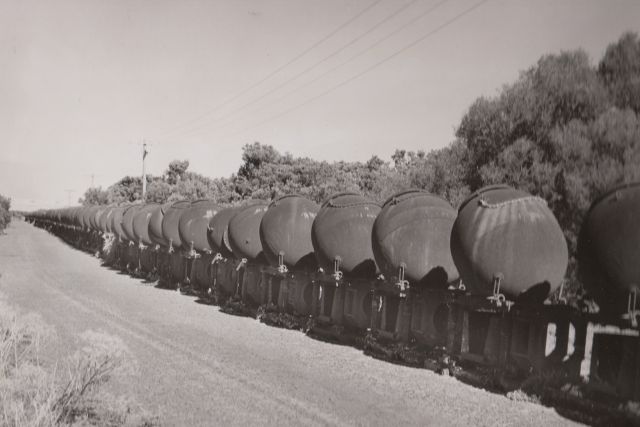
"A temporary revival in use of the line during World War 2 whilst mines were carried from the military base on Swan Island, just off Queenscliff, to Geelong. Up to 14 trains per day ran at this time."
Anecdotal information is that these trains were able to run direct to Cunningham Pier, the loading point for HMAS Bungaree, the primary RAN mine layer.
For further information about production of mines in Australia during World War 2, read or download Volume V - The Role of Science and Industry (1st edition, 1958) - Chapter 13 - Torpedoes and Mines (Australia in the War of 1939-1945. Series 4 - Civil - Volume Vol 5.)
Commander Norman Calder, OBE, RAN was the Commanding Officer of HMAS Bungaree, the RAN's only specialist mine laying ship during the war. An extract from his NHSA Monograph No. 179, HMAS Bungaree - Australia's only Minelayer, 2003, provides an additional perspective on the mining effort.
A video podcast from the Naval Historical Society of Australia titled "HMAS Bungaree" describes the Swan Island operation during World War 2.
Post War
In 1948, the depot was described thus:
"The R.A.N. Mine Depot consists mainly of a large number of buildings containing explosives, Mine and Depth Charge Stores, area approximately 400 acres - space not occupied by buildings is swampy or covered by Ti-tree, buffalo and maram grass. The Island suffers from an over-issue of rats, rabbits, opossums, mosquitoes and snakes, the latter providing some exciting moments while the summer grass cutting is in progress. ...
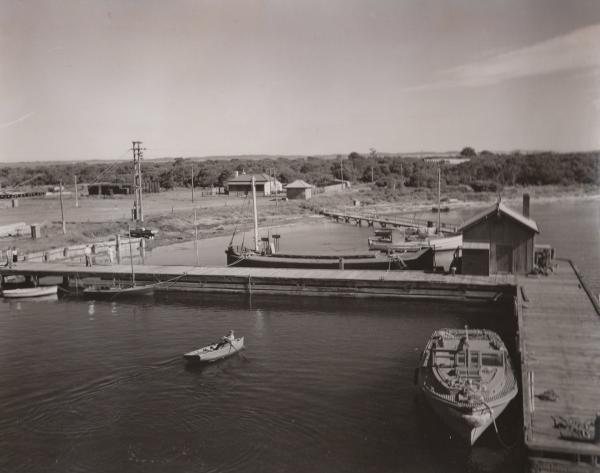
South Pier at RAN Mine Depot, Swan Island, 1953
... Swan Island staff including administrative, has been reduced from 119 including Police and Naval Guard to 66. ...
A 3 ft. gauge railway service to all Explosive sheds and main non-explosive stores is maintained by the Department of Works and Housing.
Electromobiles, chain driven by a motor supplied by 2 banks of 15 cells at 60 volts are the medium of power for haulage of double bogie trucks. This equipment is safe, sure but extremely slow.
Two motor driven trucks, 3 ton and trailer, and 30 cwt. respectively, provide the main means of transport between non-explosives stores and a 2 ton mobile tractor crane has rendered yeoman service in lifting heavy items stored in the open. ..." (RAN Mine Depot Swan Island Newsletter, May 1948)
Naval officers known to have worked at the depot include:
ENGINEER-CMDR George W. Bloomfield, RAN
- 1923 - Assistant to Mining Engineer Officer
- 1926 -1932 - Mining Engineer Officer
ENGINEER - CMDR Barry Hocken, RAN
- 1923 - 1925 Mining Engineer Officer
CAPT Edwin S. Nurse, RAN
- 1932 - 1933 - Mining Engineer Officer
LCDR Frederick G. H. Bolt, RAN
- 1934 - 1937 - Officer-in-Charge
LCDR George T. Saunders, RAN
- 1938 -1952 - Officer-in-Charge
LCDR W. Payne, RAN
- 1953 - 1957 - Officer-in-Charge, RAN Mine Depot
LT R. Soley, RAN
- 1958 - 1960 - Officer-in-Charge
Closure
The depot is likely to have closed around 1961, as this is the last year that it appears in the Navy List. The only person named is a Senior Clerical Officer, suggesting that decommissioning was occurring.
 Take a mid-20th century photographic tour through this depot: RAN Armament Depot Photo Album circa 1949-1953
The RAN Mine Depot Swan Island Chronology page contains additional information as does the page on the RAN Mine Depot Fyansford.
The photo of improvised motor haulage shown above was sourced from the Naval Historical Society podcast on HMAS Bungaree presented by Andrew Mackinnon. (https://www.youtube.com/watch?v=I0WSnpKMskg)
Like to know more? Check out other pages via the Site Map.
Material on this page may be copied for personal use. If you intend to republish any substantial part of the page in any manner, please acknowledge the source and provide the URL of the page.
